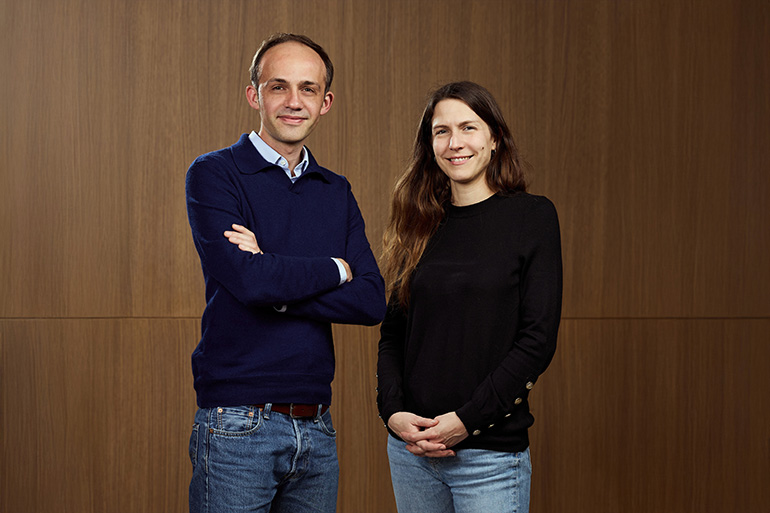
Maximilien Levesque (left), CEO of Aqemia, with Emmanuelle Martiano-Rolland, COO.
At the J.P. Morgan Healthcare Conference in San Francisco, the AI drug discovery pitch is familiar: shrink timelines, automate bottlenecks, take a process that spans a decade-plus and billions of dollars and compress it. For years, the industry has treated speed and cost as the headline metrics.
The numbers, however, still point in the wrong direction. According to Deloitte’s 2025 analysis, drug development costs rose to $2.23 billion per asset in 2024, up from $2.12 billion the year before.
Maximilien Levesque, CEO and co-founder of Aqemia, thinks he knows why. “People have observed that [AI] brings efficiency, yet it brings efficiency in making the same molecules as before… Doing ‘me-toos,’ as we say in chemistry,” he said in an interview at J.P. Morgan. “If you train your [AI] only on French, it will never invent English.” That is, AI models trained on existing molecular data can accelerate known chemistry but struggle to generate genuinely new chemical matter when there is little or no precedent.
And even if AI does make drug discovery more efficient, Levesque argues, it raises the floor for everyone. China, for instance, has grown increasingly competitive. “If [AI] brings efficiency, then it brings the same efficiency to the Chinese ecosystem,” he said. AI-driven speed gains are symmetrical: they accrue equally to every competitor with access to the same tools.
Aqemia, founded in 2019, is also betting on AI, but with a different value proposition: novelty over efficiency. Most AI drug discovery platforms learn patterns from molecules that have already been synthesized and tested. Levesque argues that approach is structurally limited. Instead, Aqemia uses physics-based calculations to evaluate atomic-scale interactions, then applies generative methods to optimize what it finds.
“We are exploring chemical space: new molecules that the other AI companies wouldn’t dare to explore,” Levesque said. “It’s so far away from their training set that their models can’t invent and predict them.”
Moonshots
Aqemia calls its approach “moonshots,” but it isn’t focused on a single grand bet. The company runs multiple parallel programs against a single indication, treating drug discovery as a portfolio problem.
Take pancreatic cancer, one of the deadliest solid tumors. Instead of advancing one candidate and hoping it survives the 90%-plus attrition rate in clinical development, Aqemia says it mapped roughly 20 distinct research programs targeting the disease through different biological strategies. Levesque said five pancreatic cancer programs are underway. They span hit optimization and early lead and extending into late lead optimization, with several progressing to animal-model efficacy studies.
“Even if each shot has a low probability of success, a few percent, by running 20 of them in parallel, we will manage to make a difference,” Levesque said. “It’s not trying to beat the odds. It’s playing the statistics.”
The strategy depends on being able to generate and test candidates inexpensively enough to run at scale. Levesque claims Aqemia’s physics-based approach lets them screen billions of molecules computationally, compared to hundreds for competitors relying on brute-force methods. “It’s very frugal in terms of computing. That’s why we are the only ones being able to do the kind of thing that we do, which is powering generative AI with physics. It’s because our physics is very efficient. It’s not compute-intensive,” Levesque said.
Levesque points to a specific bottleneck: physics-based scoring is usually too slow to serve as the engine of a generative platform. Competitors, he said, “need supercomputers to brute force” Molecular Ornstein-Zernike (MOZ), a key equation, while Aqemia has an analytical key. “It’s like: they brute force the equation, while we know the password,” he said. The payoff, he claims, is scale: “We can test billions of molecules in the computer when the competitors can test at most a few hundred.”
Traction with Big Pharma
The company has an internal portfolio but is also working with Big Pharma firms too. A multi-year partnership with Sanofi, announced in late 2023 and valued at up to $140 million, spans multiple therapeutic areas. Aqemia has also forged collaborations with Johnson & Johnson and Servier. Of the work with Big Pharma partners, Levesque notes: “They nominate the targets. They know the biology, they know the disease, and we work together.”
In terms of its internal development efforts, Levesque said the goal is to advance at least one internal program into the clinic within the next 12 months.
In the long run, Aqemia aims to make “moonshots” more of an operating model. “We identify the highest unmet medical need, so there’s no question there is a real problem,” he said. “We address it with 20 different programs.” And the company is clear about which programs to sideline if the data doesn’t look optimal. “To date, we have five programs against pancreatic cancer that are up to proving efficacy in animal models,” he said.
Filed Under: machine learning and AI