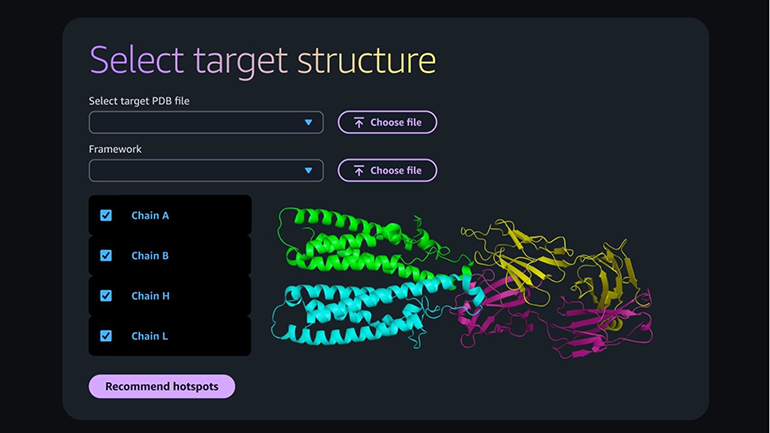
 Amazon Web Services today launched Amazon Bio Discovery, an application that routes AI-designed antibody candidates directly to DNA Synthesis firm Twist Bioscience and the techbio Ginkgo Bioworks for synthesis and testing, with results flowing back into the same interface that generated them.
AWS launched Amazon Bio Discovery with Bayer, the Broad Institute, Memorial Sloan Kettering and Voyager Therapeutics among its early adopters.
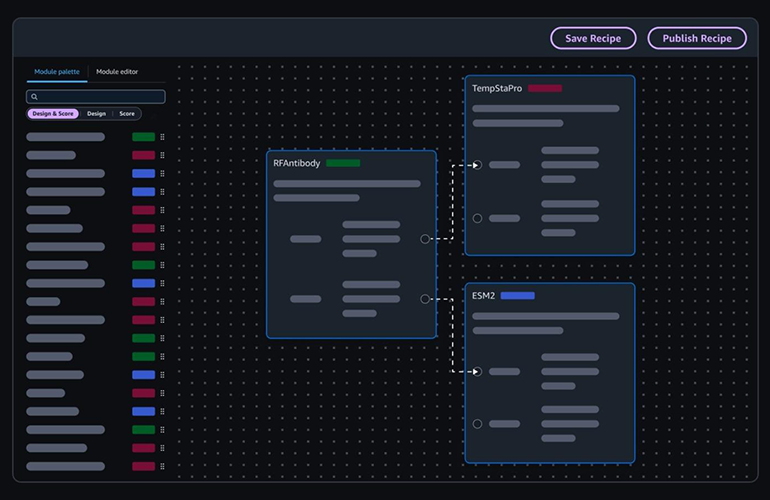
The application pairs that integrated wet-lab handoff with a catalog of biological foundation models (bioFMs), large AI models trained on biological datasets that generate and evaluate potential drug molecules, alongside a natural-language agent for experiment design and fine-tuning on proprietary lab data.
In one early project, Memorial Sloan Kettering researchers working with Nai-Kong Cheung, M.D., Ph.D., Enid A. Haupt Chair in Pediatric Oncology at Memorial Sloan Kettering Cancer Center, used Amazon Bio Discovery to orchestrate multiple models and generate nearly 300,000 novel antibody molecules. The team then sent the top 100,000 candidates to Twist Bioscience for testing. AWS says that compressed a process that can take up to a year into a matter of weeks. “Patients come here with a clock. We need results sooner,” Cheung said. The antibody design project grew out of a broader AWS-MSK collaboration announced in February 2025.
In symposium materials shared with media, AWS also outlined work with Labcorp and Datavant on an AI-powered real-world data platform for Alzheimer’s disease research; with Merck and BCG on AI-enabled clinical trial site selection; and with Verily on making Verily Workbench generally available for AWS users.
The Labcorp platform, developed with AWS and data-linkage firm Datavant, pulls from Labcorp’s blood-based biomarker testing data, which the company says is the broadest such portfolio for Alzheimer’s and dementia. Labcorp is positioning the proprietary lab data as the differentiator: AWS provides the Bedrock agents and SageMaker analytics while Datavant handles the privacy-preserving linkage that ties lab results to medical claims data and Labcorp supplies the longitudinal diagnostic record. Early use cases center on identifying patient cohorts for clinical trial recruitment, a persistent bottleneck in Alzheimer’s drug development. The Alzheimer’s version completes initial validation this spring, with planned 2026 expansions into inflammatory diseases, cardiometabolic conditions, women’s health, and oncology. Labcorp says it supported more than 85% of FDA drug approvals in 2025.
Agents are becoming the preferred frame for AI in drug discovery. Isomorphic Labs, the Google DeepMind spinout, has signed drug-design partnerships with Eli Lilly, Novartis, and Johnson & Johnson with potential value exceeding $3 billion in 2024. Insilico Medicine’s Rentosertib, developed on its Pharma.AI platform, reached preclinical candidate stage in 18 months and completed a Phase IIa trial in idiopathic pulmonary fibrosis, with results published in Nature Medicine in 2025. NVIDIA’s healthcare division is pitching a similar co-scientist architecture through BioNeMo. And in early April, Anthropic reportedly acquired Coefficient Bio, an eight-month-old drug design startup staffed by former Evozyne, Genentech and Prescient Design computational biologists, for $400 million in stock.
Filed Under: machine learning and AI